_01JMZ4H43P2JR7Z62M1XDT4TBF.png)
Turn Browsers into Buyers with Page Stream: Product-Specific Social Proof 🚀
Page Stream is one of Fomo’s most powerful conversion tools. Instead of showing a broad "Someone bought something" message, Page Stream tracks and displays activity for the exact product your customer is currently viewing. It creates an environment of high intentionality, proving that the specific item on the screen is in high demand.
The Power of Relevance: How It Works
In marketing, relevance is the shortest path to trust. Most social proof tools show general store activity, but Page Stream operates with "Product-Page Isolation." This means your social proof is always perfectly synced with the visitor's current intent.
The "Red Shoe" Illustration:
Imagine your store sells both Red Sneakers and Blue Sneakers:
-
On the Red Sneakers page (
/product/red-shoes): Fomo dynamically filters your data to show only red shoe activity. Visitors see: "Harry from Austin just grabbed a pair of Red Sneakers" or "12 people bought these in the last 24 hours."
-
On the Blue Sneakers page (
/product/blue-shoes): Fomo instantly switches gears. It will only show a count of blue shoe purchases or individual blue shoe notifications.
The CRO Advantage: By isolating data to the specific URL, you eliminate "social proof noise." A visitor looking at sneakers isn't distracted by notifications for hats or socks they are only shown evidence that validates their specific interest.
Why This Drives Growth:
-
Hyper-Relevance: Visitors see data only for the product they are currently browsing in their product pages. It eliminates "social proof noise" from other categories.
-
Proof of Momentum: By showing specific product activity, you highlight "trending" items, which naturally accelerates the decision-making process.
- Trust at Scale: It demonstrates that your individual products are being noticed and purchased, providing immediate validation for the shopper’s choice.
Note: each notification roundup is counted for that product/page only, and is not shown on other URLs.
Step 1: Activate the Stream ⚡️
-
In Fomo, navigate to the Notifications tab and click the + Add Notification button.
-
Search for Page Stream and click Connect.
- Identify your Product Path: Define your URL structure (e.g.,
/products/or/shop/) so Fomo knows which pages to track. (Shopify users no need to change anything here)
If your product path is in the format #{{domain}}/products/#{{product_title}}, then /products/ would be used for the second input above.

Step 2: Configure Your Display Options
Page Stream offers two specific settings to showcase product popularity:
Product-Level Scoping: Enabling this allows Fomo logic to go over your existing order data and organize it by product. Once active, Fomo will display individual sales notifications on the specific product page where that purchase occurred.

The Roundup Notification: This creates an aggregate social proof statement (e.g., "50 people purchased this product in the last 24 hours!").
See how it looks:

Make sure to customize your message by going to the notification editor located at the end of the settings list.

🚨 Optimize for Accuracy
To avoid "double-counting" your momentum, it is important to choose one primary metric:
-
Decide which event you want to showcase (Orders, Add to Carts, etc).
-
Select from the option list which template you want to be the primary metric or the source for the count:
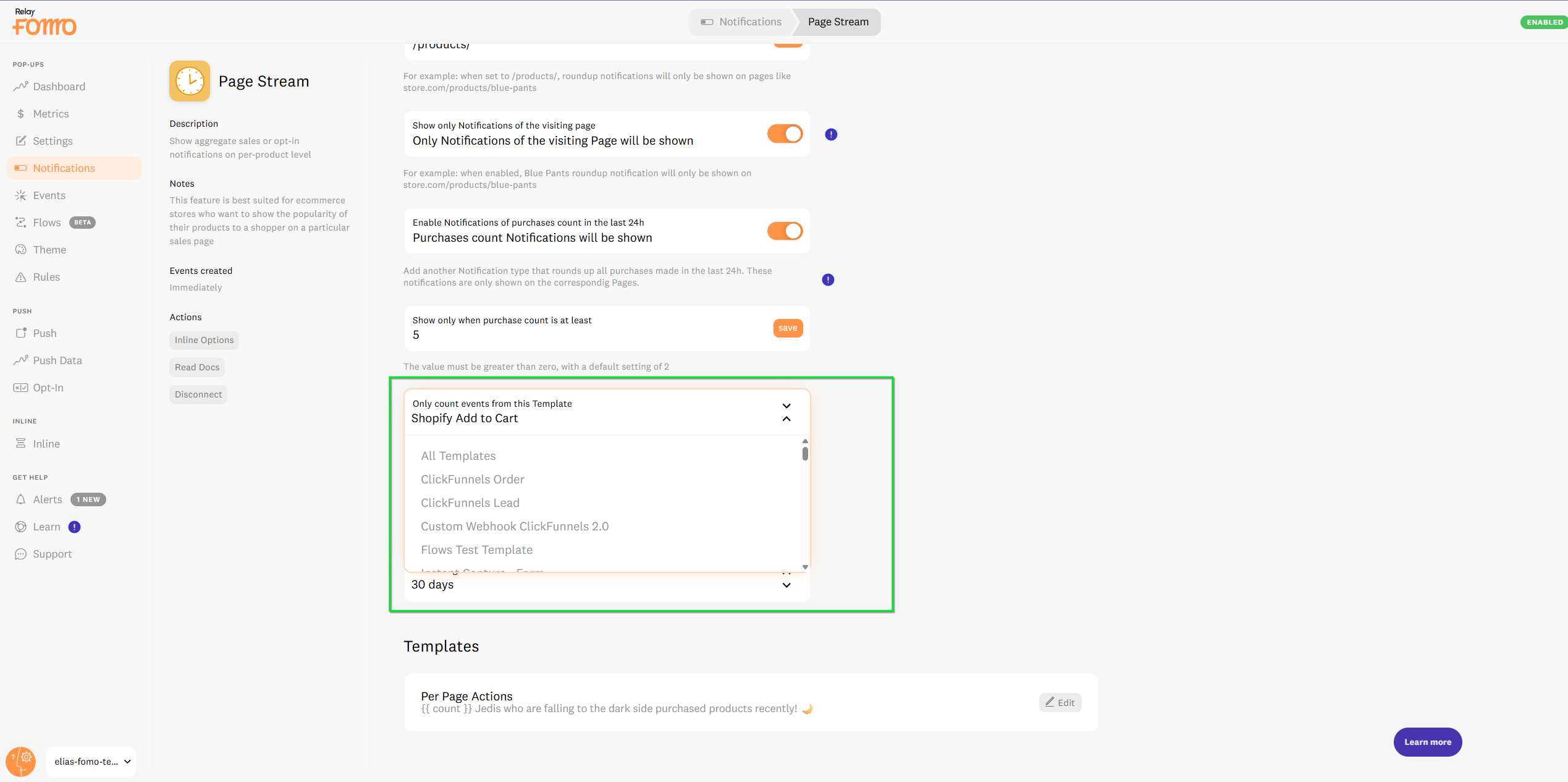
3. And that is done, we will save automatically your selection and from here and on the counter will use that temp
Important note: from the list on this section, you will see all your active notifications, meaning you might see roundup options, please never select a roundup since these are already doing the same thing and they have a source template already, the main idea here is to select a notification that:
- It is not a Roundup Notification
- It is being triggered multiple times that is why you want to use the page stream to count that behavior.
Step 3: Optimize with Thresholds & Timing
To maintain a professional brand image, you can control exactly when and how much data to show:
-
Minimum Threshold: Set a "floor" for your social proof (e.g., 5). If a specific product has fewer than 5 sales, Fomo will stay quiet. This ensures you only broadcast high-momentum activity.

Note: If a given product's sales or signups aren't at least that amount in the last 24 hours, we won't turn it into a Fomo notification.
- Time Look-back:
- For Popups: By default, Fomo looks back at the last 24 hours to keep the "busy store" vibe fresh and urgent.
-
For Inline: You have the flexibility to modify the look-back period, allowing you to aggregate sales data over a longer duration if a product has a longer consideration cycle.
🎨 Advanced: Go "Inline" for a Native Look
Page Stream isn't just for popups. You can also display the Roundup notification as Inline text, which embeds the social proof directly into your page design.
Because you can control the placement of Inline elements, you can position this social proof wherever it makes the most sense for your mobile or desktop layout.
-
Example: "🔥 15 people have purchased this in the last 24 hours."
-
The Benefit: It feels like a native feature of your store, providing constant, non-intrusive reassurance to the buyer.
👉 Explore the Fomo Inline guide here for more examples and customization options.
Advanced Optimization: Consolidating Social Proof with Canonical URLs
Page Stream identifies products based on the browser's URL. However, marketing efforts often add "noise" to your links through query parameters (like ?utm_source=facebook or ?gclid=123 ).
If your site doesn't use Canonical Tags, Fomo might treat these as separate pages, splitting your social proof in half.
💡 The "Consolidated Momentum" Example
Suppose you are running a winter sale. One customer lands on your store directly, and another lands there via a Facebook ad:
- Customer A:
yoursite.com/product/winter-jacket(3 sales) -
Customer B:
yoursite.com/product/winter-jacket?utm_campaign=winter_sale(5 sales)
Without a Canonical Tag: Fomo sees these as two different products. A visitor on the sale link only sees 5 sales.
With a Canonical Tag: Fomo recognizes both URLs belong to the same "Master" product page. It combines the data to show a much stronger total of 8 sales to every visitor.
How to Implement:
Ensure your website's <head> section includes a proper canonical link for each product page: <link rel="canonical" href="https://yoursite.com/product/winter-jacket" />
When this tag is present, Fomo automatically ignores the "noise" (UTM tags, search queries, etc.) and fetches all events related to the Canonical URL, ensuring your social proof is as high as possible.
🚀We’re Here to Help You Scale
Every business setup is unique. Whether you’re optimizing your thresholds or embedding Page Stream Inline, we’ve got your back.
-
Email us: Drop us a line at hello@fomo.com and our team will jump in to help.
- Skip the troubleshooting: . We’ll hop on a call, share screens, and help you build the perfect social proof engine. Pick the day and time here.